
Cloud ERP vs Traditional ERP: Which Is Better for FMCG Retailers?

Quick answer: Cloud ERP runs on the vendor's servers and you pay a subscription. Traditional (on-premise) ERP runs on servers you own and you pay for licenses and upkeep. For most FMCG retailers, cloud ERP wins on upfront cost, speed of rollout, multi-store visibility and AI features. Traditional ERP still fits a few cases, such as strict data-residency rules or unreliable internet.
What is cloud ERP, and what is traditional ERP?
Traditional ERP (also called on-premise ERP) is installed on servers inside your own office or data centre. Your IT team maintains the hardware, applies updates and manages backups.
Cloud ERP is hosted by the vendor and used through a browser or app. Updates, backups and infrastructure are handled for you, and you pay a recurring subscription.
How cloud ERP works

Your team uses any device with a browser or app. Every store connects over a secure internet link to one vendor-hosted system with a single shared database. The vendor handles security, automatic backups and updates, so there are no servers for you to run.
Cloud ERP vs traditional ERP at a glance

In short, cloud ERP is stronger on upfront cost, go-live time, access from any store, automatic updates, scaling to new stores and AI features. Traditional ERP is stronger on deep customisation and on working without a stable internet connection.
Where does the money go?
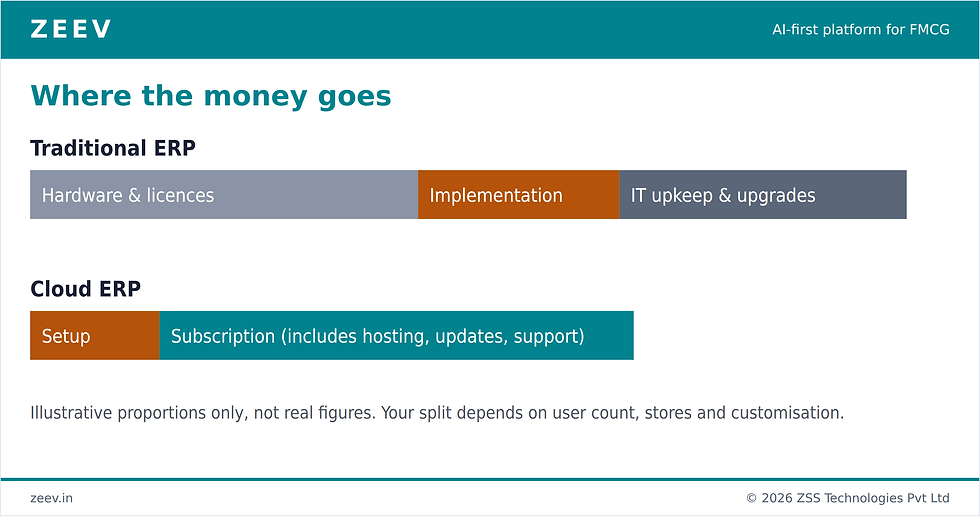
The biggest difference is not the total bill but when and on what you spend. Traditional ERP front-loads cost into hardware and licences. Cloud ERP spreads it into a predictable subscription.
The chart is illustrative, not real figures. Always compare a 5-year total cost of ownership, not just year one.
Six benefits of cloud ERP for FMCG retailers
Lower entry cost. No server room or large licence purchase. Start with the stores you have today.
Real-time visibility. See stock, sales and purchases across every outlet from one dashboard.
Faster rollout. No hardware to procure, so a new store can be live far sooner.
Always up to date. GST changes, new features and fixes arrive automatically, with no manual upgrade projects.
Built-in AI. Features such as reading purchase invoices and suggesting replenishment ship as part of the platform.
Easy to scale. Adding outlets, users or SKUs is a configuration change, not an infrastructure project.
When traditional ERP still makes sense
Cloud is not automatically right for everyone. Traditional ERP can be the better fit if you have:
Regulatory or contractual rules that require data to stay on your own premises.
Heavy bespoke workflows that a configurable platform cannot support.
Locations with unreliable internet where offline operation is essential.
How to decide: a 5-question checklist
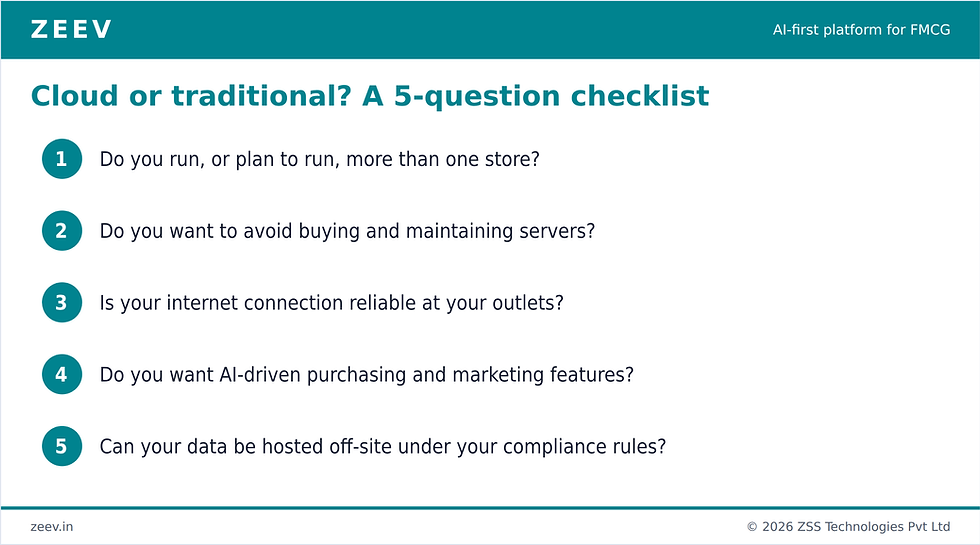
Do you run, or plan to run, more than one store?
Do you want to avoid buying and maintaining servers?
Is your internet connection reliable at your outlets?
Do you want AI-driven purchasing and marketing features?
Can your data be hosted off-site under your compliance rules? Mostly "yes"? Cloud ERP is likely the better fit. Mostly "no"? Evaluate traditional or hybrid options.
How Zeev fits in
Zeev is an AI-first ERP and billing platform for FMCG retailers, connecting department stores, distributors, manufacturers and consumers. It reads purchase invoices, automates replenishment and runs voucher-based marketing, so store teams spend less time on manual entry. Zeev supports over 300 stores today. Learn more about purchase automation, the CPG platform and pricing, or start with Zeev for free.
Frequently asked questions
What is the main difference between cloud ERP and traditional ERP?
Traditional ERP runs on servers you own and maintain. Cloud ERP runs on the vendor's infrastructure and is accessed through a browser or app on a subscription.
Is cloud ERP cheaper than on-premise ERP?
Usually cheaper upfront, since there is no hardware or large license purchase. Over many years it depends on users, customization, and IT overhead, so compare a 5-year total cost of ownership.
Is cloud ERP secure?
Reputable vendors provide encryption, access control and backups. Security still depends on the vendor's practices and how you manage user access, so ask for their security documentation.
Can a small retailer use cloud ERP?
Yes. Subscription pricing and no hardware make it practical for single-store and multi-store retailers, and it scales as you add outlets.
When is traditional ERP still the better choice?
When you have strict data-residency rules, heavy bespoke customization, or unreliable internet.


Comments